
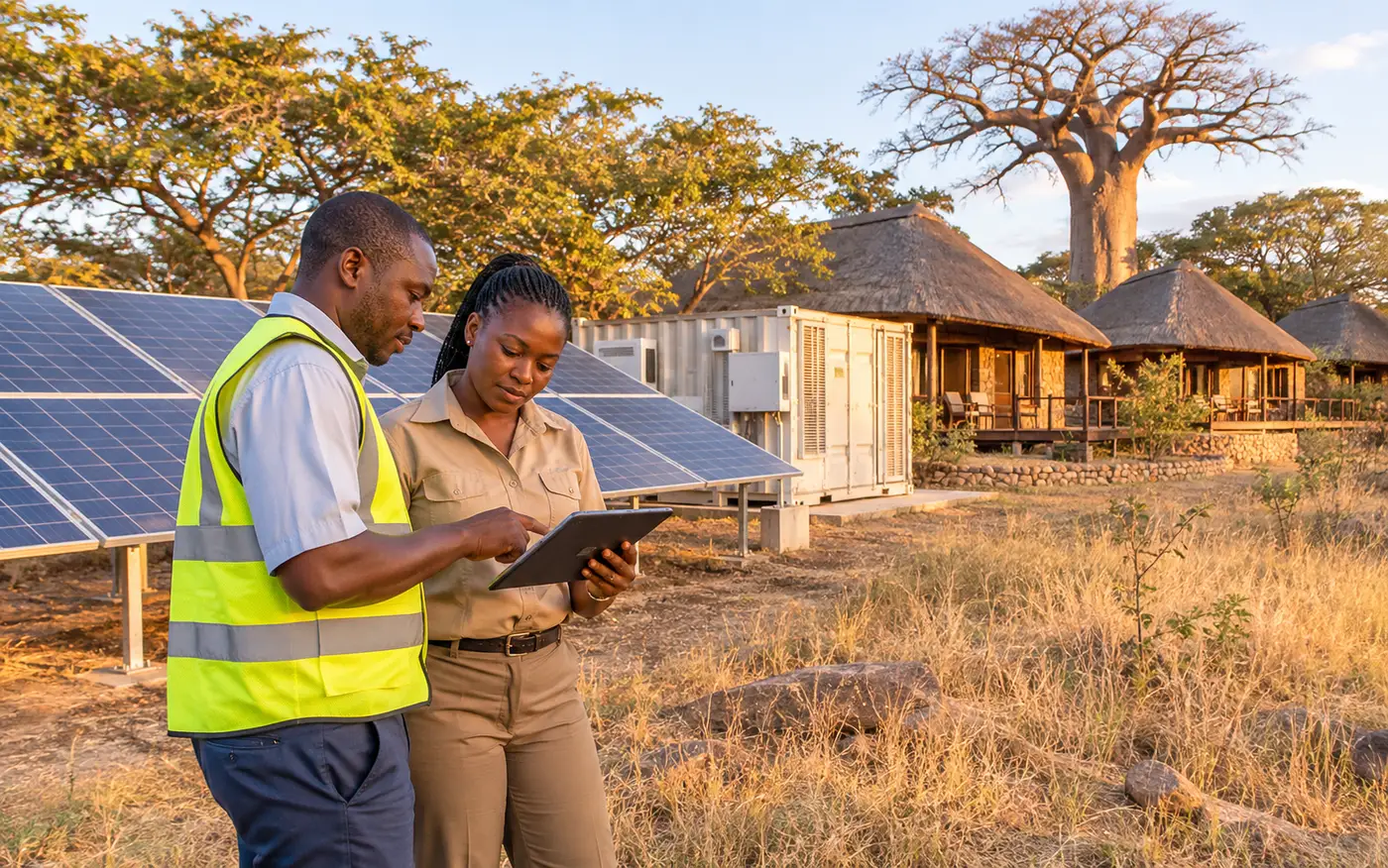
Lodges and hotels in Zimbabwe: cutting energy cost without cutting the guest experience
Guests remember the view, not the electricity bill, but the owner does. Here is where a lodge's energy goes and how to cut it.
In this article
Key points
- Most hotel energy goes on air conditioning, ventilation and hot water. Hot water alone is about a fifth to a quarter.
- Power use follows how many guests are in. The best savings follow the guest too: room controls, scheduling and zoning.
- Hot water is the best place to start with solar or heat pumps, because the demand is steady, large and easy to store.
- Remote lodges depend on solar, batteries and generators. The real question is how to cover the evening peak without running the generator all night.
- Guest comfort sets the limit. A saving that spoils the guest's stay defeats its purpose.
Tourism is one of Zimbabwe's most visible service industries, and it puts a special demand on electricity. A hotel in Harare or Victoria Falls runs air conditioning, lifts, kitchens, laundries and hot water around the clock. A safari lodge in the bush needs the same services. But it often makes its own power from solar panels, batteries and a diesel generator. In both cases, the guest's experience depends on a reliable supply. The owner's profit depends on what that supply costs.
Where the energy goes
Most published studies of hotel energy come from cooler countries, and the shares change with climate, hotel type and service level. The United States Energy Information Administration reports on hotels and similar buildings in the United States. It finds that water heating and space heating each use about 20% of the energy. Lighting, cooling, refrigeration and computing each use 10% or less. A guidance document for Mediterranean hotels puts heating, ventilation and air conditioning at about 40% of all energy, and hot water for guests at 25 to 30%. A study of Moroccan hotels found lighting and cooling at about 17% each, heating at 14%, kitchens at 12% and laundries at 6%.
These differences show that no benchmark replaces measuring your own site. A hotel in a warm climate spends more on cooling than on heating. A hotel with a large conference trade has different kitchen and lighting loads from a leisure lodge. The studies do agree on one point. Three systems use most of the energy: air conditioning and ventilation, hot water, and the kitchen and laundry. The rest is a long tail of lighting, lifts and equipment.
- Space heating20%
- Water heating20%
- Lighting, cooling, refrigeration, computing and other (each 10% or less)60%
US data. In a warm climate cooling carries more weight than heating, so measure your own site. Source: US Energy Information Administration
Following the guest: controls that know who is in the room
The key point about hotel energy is simple. A room should use power only when someone is in it. A room cooled all day while the guest is out wastes energy. A room that stands empty for weeks in the low season should not be cooled at all. Several measures deal with this. Key-card master switches cut the power to the lights and air conditioning when the guest leaves. Occupancy thermostats let the temperature drift when the room is empty and bring it back when the guest returns. Property management software can set empty rooms back automatically. It can also cool a room just before the guest arrives. These measures work only on empty rooms, so the guest notices no change.
Air conditioning and ventilation
In warm climates, cooling is the biggest load in most hotels. The savings come from three places. The first is the cooling plant itself. Well-kept chillers and split units use much less energy than neglected ones. Their coils are clean and they hold the right amount of refrigerant. Modern units with variable-speed compressors and fans are far more efficient when they run at part load. The second is the pumps and fans that move the cool air and water. Fitted with variable-speed drives, which let a motor slow down when demand is low, they use much less power. Our article on motors, air and drives explains this for factories. The third is the building. Shading, insulation, sealed doors and windows, and less heat from lights all reduce the cooling load the plant has to meet.
Hot water: the natural place for solar and heat pumps
A hotel uses a lot of hot water, mostly in the morning and evening. The demand is regular, and the water is easy to store in insulated tanks. This makes hot water the best match for two technologies. Solar thermal collectors heat water directly from the sun. Heat pumps work like a fridge in reverse: they move heat from the air into the water, using only a fraction of the electricity that an ordinary heating element needs. If your hotel heats water with electric elements, replacing them with solar thermal or a heat pump is often the most valuable single measure. It removes a load that runs every day of the year. You can also recover heat from the air-conditioning and refrigeration plant. That heat gives you pre-warmed water at almost no extra energy cost.
Kitchens and laundries
Commercial kitchens and laundries use a lot of energy for every square metre. There are several ways to cut this. Fit extraction hoods with demand control, so they run at full speed only while cooking is going on. Recover heat from the refrigeration and the dishwashing. Choose better equipment, because induction hobs and modern combination ovens use less energy than older appliances. In the laundry, efficient washers with heat recovery and proper care of the dryers cut both energy and water use. In every case the saving depends on the habits of your staff. So training and simple operating rules matter.
Powering the remote lodge
A lodge beyond the reach of the grid must make its own electricity. In the past that meant a diesel generator running most of the day. Today the better answer is a hybrid system, which combines more than one source, here solar, batteries and a generator. The solar panels supply the daytime load and charge the batteries. The batteries carry the evening and night load. The generator starts only when the batteries run low. The hard part of the design is the evening. Guests return, cook, light the camp and use cooling, and the sun has gone. To size the batteries and decide how many hours the generator must still run, you need an hourly load profile, not a daily total. Our guide to sizing solar plus battery explains the method. The article on diesel cost shows how to work out what a kilowatt-hour from the generator really costs, including delivery to a remote site.
A remote lodge has one more advantage. Its guests come partly for the quiet and the wildlife. A generator that runs less often is a better neighbour to both. A well-designed hybrid system cuts noise and fumes as well as cost.
A sensible order of work
In most hotels the order that works begins with metering and an energy audit. These show you the large loads and the waste in empty rooms. Do the cheap measures first: occupancy controls and plant maintenance. Next, convert hot water, the largest and steadiest heat load, to solar or a heat pump. Then upgrade the lighting and add controls. Finally, size the solar panels (photovoltaic, or PV, panels turn sunlight into electricity) for the daytime electrical load that is left. At every step, check the effect on comfort. A saving that the guests notice is a loss.
How AVEX GRID helps
- Hospitality energy audit. An energy audit is a survey of where a site uses energy and where it can save. We meter the large loads, find the waste in empty rooms and rank the measures by payback.
- Hot water and solar design. We size solar thermal, heat pump and photovoltaic systems to your load.
- Off-grid and hybrid lodge design. We design the solar, battery and generator system on an hourly profile and calculate the fuel saved.
What AVEX GRID can take off your hands
AVEX GRID is an engineer-led energy consultancy in Zimbabwe. We do the technical work that turns an energy investment into a plant that is licensed, connected, financed and performing, whether you are a local operator or an investor overseas.
We quote fixed prices after a free scoping call and reply the same working day.
Frequently asked questions
What is the biggest saving in a hotel?
It depends on the site, but hot water and air conditioning are the largest candidates. Occupancy-based room controls are the cheapest and fastest.
Can a lodge run entirely on solar?
Many can run most of the time on solar and batteries, with a generator for long cloudy periods. The evening load decides the battery size.
Will the measures affect the guests?
They should not. Controls act on empty rooms, and hot-water and solar measures are invisible to guests. Any measure that reduces comfort should be rejected.
Is a heat pump better than solar thermal for hot water?
Both work. The better choice depends on the load, the roof space and the electricity price, and an audit compares them on cost.
Sources and notes
General information to help you plan. The rules that apply to your site are confirmed by AVEX GRID against the current gazetted text, ZERA and ZETDC as part of the work. The sources used are listed below.