

Thermal Imaging & Peak-Load Verification
Failed air conditioners and burnt-out machines during load-shedding cost Zimbabwean businesses real money. Find out what your load really is before you buy solar.
In depth
Thermal imaging for electrical faults: what it finds and how to act on it
Heat is the most common early sign of an electrical fault. A connection with extra resistance turns part of the current into heat. The effect grows with the square of the current. So a joint that is only slightly warm at light load may be dangerous at full load. Thermal imaging measures that heat without touching the equipment.
How a survey works
- Plan. List the equipment: switchboards, motor control centres, transformers, bus bars, disconnects, large motors and critical circuits.
- Choose the conditions. The plant should run at a typical load, ideally more than half of its normal maximum. Write down the load during the survey.
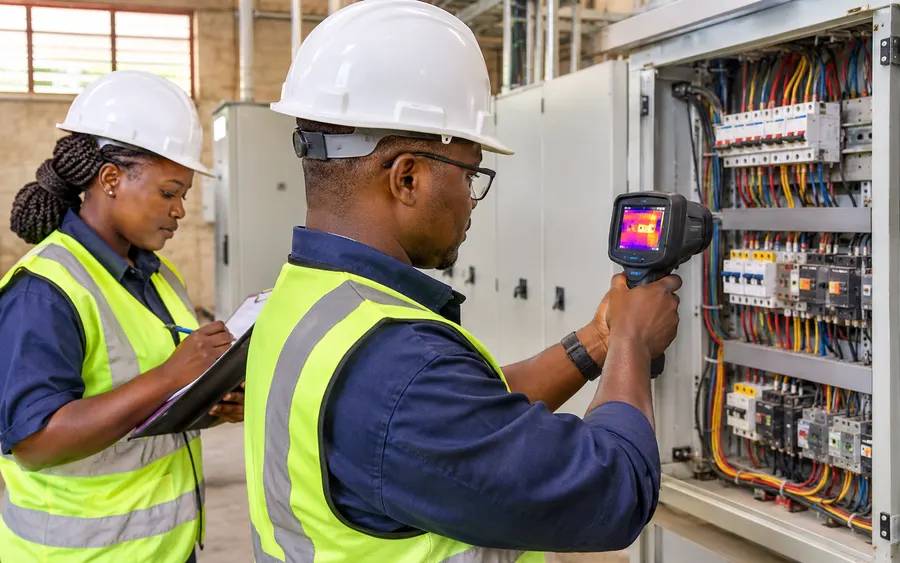
- Scan. Covers are removed where it is safe, or the camera looks through inspection windows. The camera records images of each part and its surroundings.
- Compare. The thermographer is a trained person who takes and reads thermal camera images. The thermographer compares like with like, such as the three phases of the same connection. The thermographer also notes how…
Reading the severity
Severity depends on three things: how far the temperature is above a reference, the load at the time, and what a failure would cost you. A small rise on a non-critical circuit can wait for the next planned outage. A large rise on a main incomer or a critical process needs action soon.
The ISO 18434 series of standards describes how to judge severity. ISO is the International Organization for Standardization, which writes international standards. The series covers thermography, overloads or failing equipment. Many sites also set their own priority bands in the maintenance plan.
Limits of the method
- It sees surface temperature. Equipment behind closed panels needs inspection windows or safe access with covers off.
- Shiny surfaces reflect heat and can mislead. A trained thermographer allows for this.
- It only shows faults that produce heat. Other faults need other tests, such as insulation testing or power-quality measurement.
Read the full guide: Thermal imaging for electrical faults: what it finds and how to act on itAlso covered: Survey frequency · What a good thermal survey records · From finding to repair
What you get
Results you can take to your board or lender
Hot spots found early
Loose connections and overloaded circuits found before they fail.
Peak load understood
Loading data that shows where capacity is tight.
A clear action list
Findings ranked by risk, with fixes.
Deliverables
What lands in your inbox
- Heat-camera survey of selected panels
- Snapshot of loading
- Findings ranked by risk, with photos
- Recommendations
 Transformer inspection
Before the call
What to bring
Rough information is fine. This is what lets us scope and quote quickly.
- Single-line diagram and a list of boards to inspect
- When your load peaks and any past failures
- Safe access to your switchrooms
- Ratings of your main motors and drives
How we work
From first message to finished work
- 1
Brief
A short call or message. Tell us about your site, your deadline and what is at stake. We reply within one working day.
- 2
Scope & fixed quote
We agree exactly what we will deliver, what we need from you, the timeline and a fixed price, before any work starts.
- 3
Engineer & document
We study your data, test the options and write the report or application, with every assumption stated.
- 4
Hand over & support
You get the finished package and a walk-through. We stay available while it is reviewed, approved or built.
Questions we hear
Before you book
Is the survey disruptive?
No. Most surveys are done while your equipment runs normally.
Keep reading
The full guide, in plain English
 Guide Maintenance · 5 min read
Thermal imaging for electrical faults: what it finds and how to act on it
An infrared survey finds the hot connections, overloaded circuits and failing components that lead to outages and fires. This guide explains how a survey works and how to read the findings.
How a survey worksReading the severityLimits of the methodSurvey frequencyWhat a good thermal survey recordsFrom finding to repair
Read the full guide
More guides that go with this page
 Power systems · 10 min readArc flash and ETAP studies in Zimbabwe: what they are and when you need oneRead the guide
 Power quality · 11 min readPower factor correction in Zimbabwe: stop paying for reactive powerRead the guide
 Tariffs · 7 min readHow to cut maximum demand charges in Zimbabwe: seven tactics that workRead the guide
Talk to an AVEX GRID consultant
Have a project in mind, or want a second opinion on a quote you have received? Send us a short message and we will reply within one working day.