
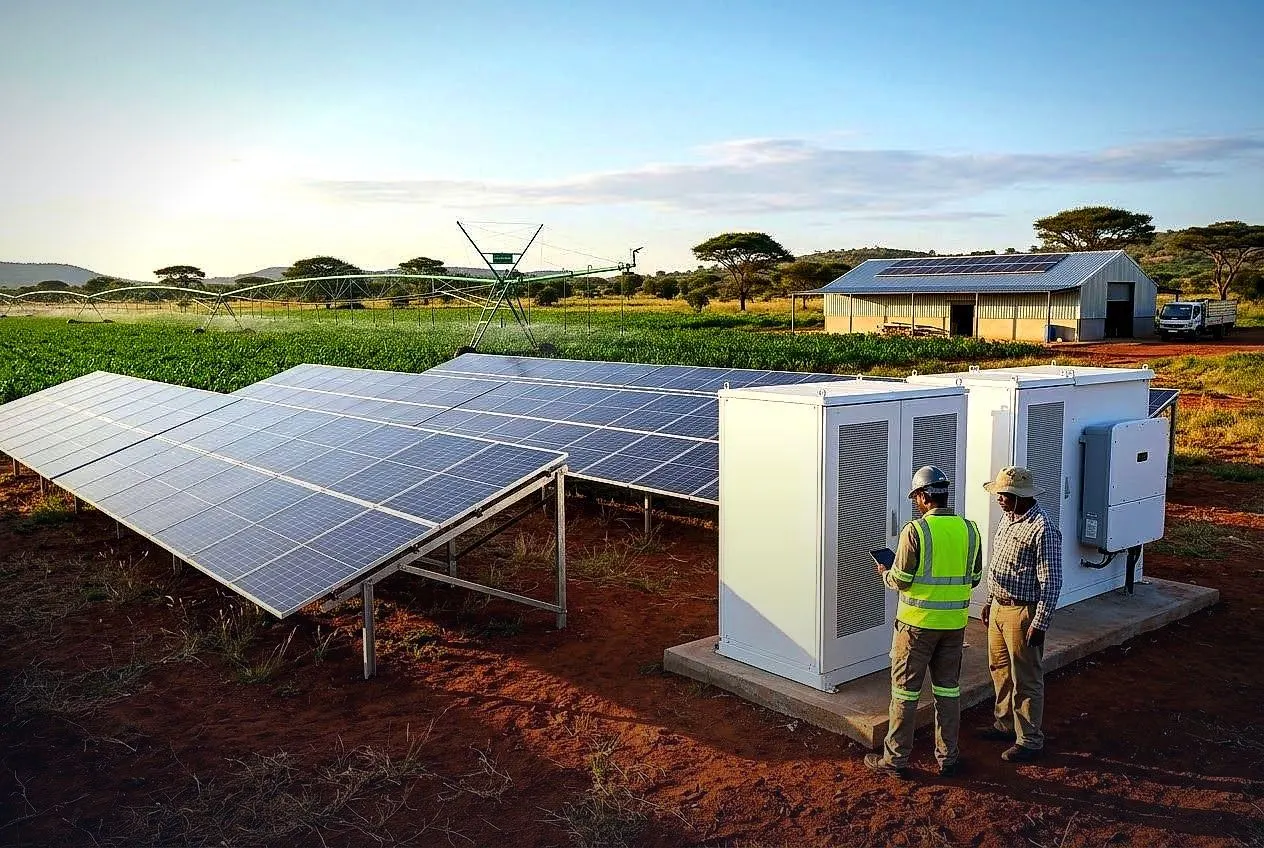
Hybrid solar microgrids for farms and agro-processors in Zimbabwe
A farm cannot tell a crop to wait for the grid. Irrigation, cold rooms, curing barns and packhouses all have hours when power is not optional.
In this article
- Why a hybrid, not "just solar"
- A sizing method you can follow
- Costs and incentives
- Common mistakes
- A worked example: sizing a solar borehole
- Cold rooms and the value of thermal storage
- Controllers, protection and the generator
- Paying for it and keeping it working
- Planning around the farming calendar
- How AVEX GRID helps
Key points
- The World Bank has noted that power shortages undermine irrigation, cold chain and storage in Zimbabwean agriculture.
- A hybrid system combines solar, batteries, the grid and a generator, with a controller that chooses the cheapest source each hour.
- Pumps and cold rooms are good solar loads: they run in daylight or can store energy as water or cold.
- Size from the load profile of your busiest month, not from a rule of thumb or the roof area.
- Keep the generator. Make it the last resort instead of the default, and the diesel bill falls sharply.
津巴布韦农场与农产品加工厂的光伏混合微电网
- 世界银行指出,电力短缺影响津巴布韦农业的灌溉、冷链和仓储。
- 混合系统将光伏、电池、电网和发电机结合,由控制器每小时选择最便宜的电源。
- 水泵和冷库是适合光伏的负荷:它们在白天运行,或可把能量储存为水或冷量。
- 应按最忙月份的负荷曲线确定容量,而不是靠经验公式或屋顶面积。
- 保留发电机,但让它成为最后手段而不是默认电源,柴油开支会大幅下降。
- AVEX GRID 可做负荷测量、混合系统建模与方案设计(英文沟通)。
联系方式:WhatsApp +7 900 131 7406,邮箱 inquiries@avexgrid.com。
Zimbabwean agriculture is moving to solar for a plain reason: diesel and power cuts cost money in the field. Farmers in Beitbridge switched to solar irrigation after fuel costs and power cuts disrupted their production cycles. Pay-as-you-go schemes now target small farmers too. For larger farms and agro-processors, the question is how to combine solar with the grid and a generator so that the system stays reliable. This guide sets out the method.
Why a hybrid, not "just solar"
Solar alone produces only in daylight. Batteries move some of that energy into the evening, but each hour of storage costs money. The grid and a generator cover the rest. A hybrid controller decides, minute by minute, which source to use. The result costs less than diesel and is more reliable than the grid alone.
| Load | Solar fit | Design note |
|---|---|---|
| Irrigation pumps | Excellent: runs when the sun shines | Variable-speed pump drives follow the sun; water storage acts as a battery |
| Cold rooms and ice banks | Very good | Pre-cool in daylight; insulation and thermal mass carry the night |
| Packhouse lines | Good in the day | Peak motor starts need soft starters and a stiff supply |
| Tobacco curing barns | Fans and controls only | Heat usually comes from wood or coal; solar powers the fans |
| Dairy and milk cooling | Good, twice-daily milking peaks | Battery or ice storage for the early milking |
Winter output is about 21% below spring, which the design must allow for. Source: profileSOLAR (NASA POWER data)
A sizing method you can follow
- List the loads. For each machine, note the kW, the hours per day and the months it runs. Pumps and cold rooms usually dominate.
- Find the critical load. What must keep running through a power cut? It could be cold rooms, a milking parlour or a borehole. Size the batteries and generator around that list.
- Estimate solar yield. Most of Zimbabwe yields roughly 1,600 to 1,800 kWh per kWp per year. A kWh, or kilowatt-hour, is the energy of 1,000 watts used for one hour. It is the unit your meter counts and your bill charges for. A kWp, or kilowatt-peak, is the rated size of a solar array under standard test conditions. A 100 kWp array can make up to about 100 kW in full sun. The Global Solar Atlas gives a figure for your coordinates.
- Compare with your energy cost. Count the diesel litres and grid kWh that solar would replace, using your real prices.
- Design the protection. Hybrid systems need correct earthing, protection against power flowing back into the grid, and a controller that handles the generator safely. Earthing is a safe path to the ground for fault current. It protects people and equipment.
Costs and incentives
Farmers' groups said in 2025 that taxes on solar installations were holding back uptake. They had asked for VAT relief, but the budget did not include it. We check duties and VAT on the equipment before you fix a budget.
Common mistakes
- Sizing the battery to run the whole farm overnight, when a smaller critical-load battery would do.
- Buying a pump with a fixed-speed motor and then wondering why the solar array cannot start it.
- Skipping a monitoring system, so no one notices when an inverter has a fault for weeks. The inverter is the device that changes the direct current from solar panels or batteries into the alternating current your equipment uses.
- Ignoring dust and shading on the array, which can cost more than a small design error.
A worked example: sizing a solar borehole
Irrigation is the best place to see the method, because you can calculate the load from physics instead of guessing. The electrical power a pump draws depends on its flow and the total head, which is the height the water must be lifted. You multiply flow by head, then divide by a constant and by the combined pump and motor efficiency. In everyday units, the power in kilowatts is about the flow in cubic metres per hour times the head in metres, divided by 367 times the efficiency.
Take a borehole that must deliver 40 cubic metres per hour against a total head of 60 metres, with a combined efficiency of 55%. The pump needs roughly 40 times 60 divided by 367 times 0.55, which is about 12 kW.
Say the farm needs 240 cubic metres a day. The pump then runs for six hours and uses about 71 kWh. An array of roughly 15 kWp covers that comfortably, even in winter, when the chart above shows output about a fifth below spring. You need a variable-speed drive, so the pump can follow the sun. No battery is required, because the water pumped into a tank or dam is the stored energy. This is why irrigation is usually the first and cheapest load to move to solar.
The mistakes tend to be in the details. One is taking the head from the borehole depth without allowing for pipe friction. Another is a fixed-speed pump that cannot start on a weak array. A third is a drive without dry-run protection when the water table drops.
Cold rooms and the value of thermal storage
A cold room is a battery that is already installed. The insulated space and the produce inside hold the cold. A well-controlled compressor can pre-cool the room in the middle of the day, when solar is plentiful, and coast through the evening. A compressor is the machine that squeezes the cooling gas, and in a cold room it is the biggest power user. So the sizing question is how many hours the room can hold its temperature with the compressor off. That depends on the insulation, on keeping doors shut and on the thermal mass of the produce.
For crops that spoil quickly, such as tomatoes and some horticultural exports, an ice bank or phase-change store adds hours of cover. It costs much less than the same capacity in lithium batteries. Winrock International's work on solar cold rooms in Zimbabwe, listed below, describes this kind of installation.
The weak point is usually electrical, not thermal. A compressor pulls a large surge of current when it starts, so a small inverter can trip each time. Specify the starting method, a soft starter or a drive, and ask the inverter supplier to confirm that it can carry the surge.
Controllers, protection and the generator
A hybrid system combines more than one source, for example solar, batteries and a generator. It is only as good as its controller. The controller has to do three things:
- keep the generator off while the solar array and battery can carry the load;
- start the generator before the battery is empty;
- stop the array from feeding power into the generator, which cannot absorb it.
It must also stop solar from pushing a running generator below its minimum load. Lightly loaded diesel engines burn more fuel for each kilowatt-hour and can suffer carbon build-up.
Where the farm also connects to the grid, the system needs anti-islanding protection and registration, as described in our net metering guide. Anti-islanding switches a solar system off when the grid is down, so it does not feed power into a line that workers think is dead. Where the farm is not connected, the design still needs correct earthing, a safe way to isolate each source and clear labels. A farm electrician may be the one who finds the system in the dark.
Paying for it and keeping it working
In April 2025 IRENA published an assessment of decentralised renewable energy for Zimbabwean agriculture. It puts the sector at the centre of the economy, supporting around 70% of the population and a large share of jobs. It studies five value chains: maize, groundnuts, tomatoes, mangoes and fisheries. It argues for business models that let smallholders adopt the technology, such as pay-as-you-go and shared equipment. It also calls for quality standards and training so that systems keep working. For commercial farms the same logic applies in a different form. The saving comes from diesel you no longer buy and from losses you avoid. So test the investment case on the farm's own diesel records and spoilage, not on a regional average.
Many projects fail quietly in operation. Inverters report faults that nobody reads. Panels lose output to dust and bird droppings. Batteries are drained deeper than they were sized for. A monitoring screen that sends an alert to the manager's phone helps. So do a cleaning schedule tied to the dry season and a maintenance contract with named response times. Over ten years they are worth more than a slightly cheaper panel.
Planning around the farming calendar
A farm's load changes through the year, and the design has to follow it. Irrigation demand peaks in the dry season, when sunshine is plentiful and the array is productive, which is a good match. Winter output is lower. Cool-season crops and a dry spell can raise pumping hours at the same time, so the winter month is the one to design for. Summer rain brings cloud and less pumping, but it may coincide with processing or storage peaks. Tobacco and horticulture have curing and grading seasons that add motor and fan loads for a few months.
Build a month-by-month table of energy need against expected solar output. Mark the months in which you will still need the generator, and size the system for the busiest of them. If you size for the average month, the farm is left short exactly when the crop depends on the supply.
How AVEX GRID helps
- Load survey and hybrid sizing for farms, packhouses and cold chains.
- Protection and controller design with a generator integrated safely.
- Registration support where the system connects to the grid. That means ZETDC and ZERA.
- Owner's engineer checks on the installer's design, commissioning and handover.
What AVEX GRID can take off your hands
AVEX GRID is an engineer-led energy consultancy in Zimbabwe. We do the technical work that turns an energy investment into a plant that is licensed, connected, financed and performing, whether you are a local operator or an investor overseas.
We quote fixed prices after a free scoping call and reply the same working day.
Frequently asked questions
Where does the pump power formula come from?
From the weight of the water lifted per second times the height: hydraulic power is density times gravity times flow times head, and the electrical power is that divided by the combined pump and motor efficiency. With flow in cubic metres per hour and head in metres, it simplifies to flow times head divided by 367 times the efficiency, in kilowatts.
How do I size a solar pump?
Start from the flow you need and the total head, including pipe friction. Pump power in kilowatts is roughly flow in cubic metres per hour times head in metres, divided by 367 times the combined efficiency. The array is then sized to run that pump through the day, with a drive that lets it follow the sun.
Can solar run my irrigation pumps without batteries?
Often yes. Pumps can run on daylight alone through a variable-speed drive, and stored water acts as the battery.
Do I still need a generator?
Usually yes, as a backup for long cloudy spells or critical loads. A hybrid controller keeps it off until it is needed.
What size system does a cold room need?
It depends on the room volume, product and insulation. We size from a measured load profile, not a rule of thumb.
Do I need ZERA approval for a farm solar system?
Grid-connected systems need ZETDC and ZERA approval or registration. Fully off-grid systems may have different requirements; we confirm the current rules for your site.
Sources and notes
General information to help you plan. The rules that apply to your site are confirmed by AVEX GRID against the current gazetted text, ZERA and ZETDC as part of the work. The sources used are listed below.
- IRENA: Decentralised renewable energy for agriculture in Zimbabwe (2025)
- World Bank: Country Economic Update, Electrifying Zimbabwe's growth (Dec 2023)
- The Herald: Beitbridge farmers embrace solar irrigation
- The Independent: Solar installation tax riles farmers
- Winrock International: Zimbabwe solar cold room
- Global Solar Atlas (solar yield for any site)