
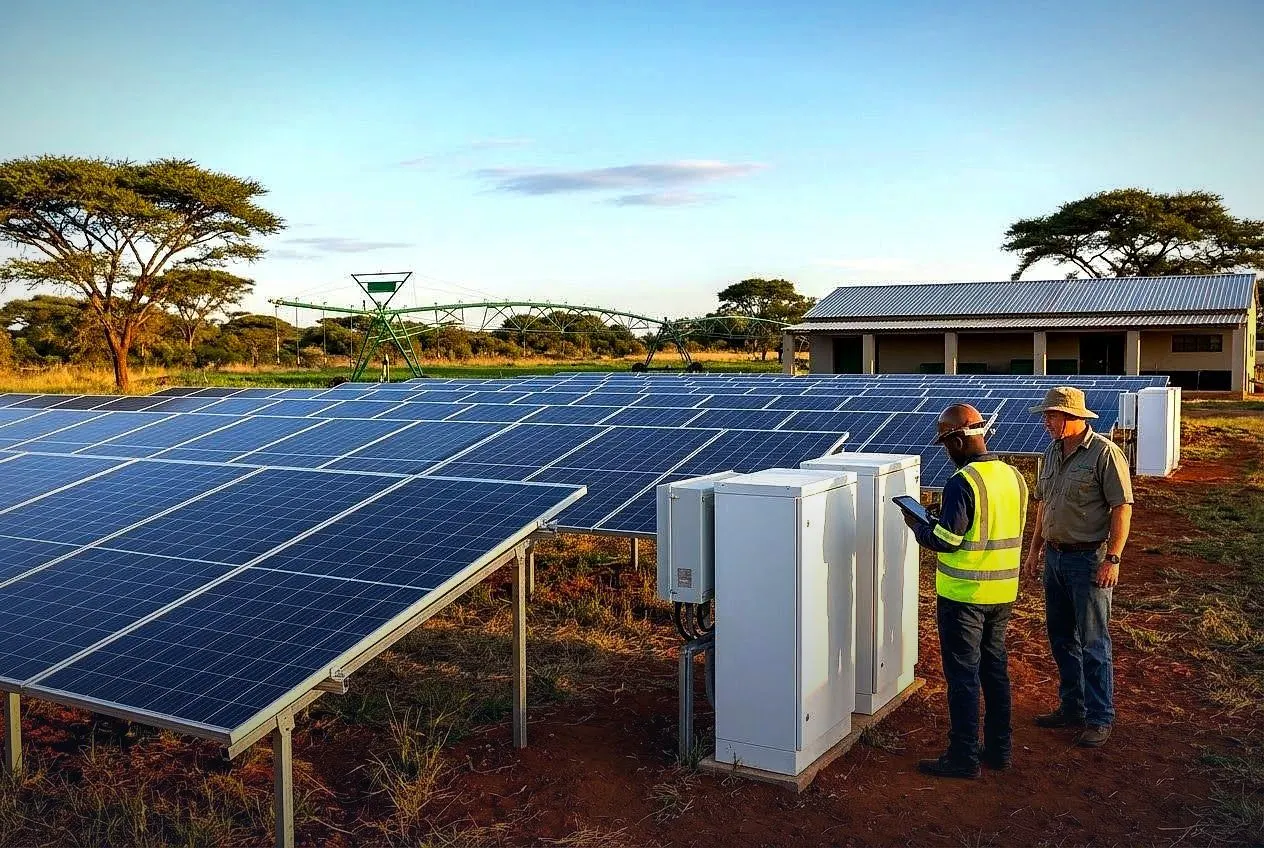
Powering donor-funded clinics and NGO sites: design, procurement and maintenance that last
Many donor-funded solar systems in rural clinics stopped working within a few years. The technology was rarely at fault; design, buying and maintenance were.
In this article
Key points
- About one billion people use health facilities with no or unreliable power (WHO, World Bank, IRENA, 2023), so the need is large.
- Solar direct-drive vaccine fridges run straight from the panels without batteries. Choose them by how long they stay cold when the sun is poor.
- Size the system for the clinic's essential load, with realistic growth, not a wish list. It will be more reliable.
- Buying on the lowest price, not the lowest total cost over the life of the system, is the commonest cause of early failure.
- A funded maintenance plan, with someone named as responsible and spare parts on hand, matters as much as the equipment.
On the day it is commissioned, a donor-funded solar system at a rural clinic is a clear success. There are lights in the delivery room, a working vaccine fridge and a phone charger for the nurse. What decides whether the money was well spent is how the system looks five and ten years later. Too many are found with dead batteries, tripped inverters and panels covered in dust. This article sets out the engineering and management practices that prevent that.
The size of the need
The Energizing Health report came out in January 2023. It was published by the World Health Organization, the World Bank, the International Renewable Energy Agency and Sustainable Energy for All. It estimated that close to one billion people are served by health facilities with no electricity or an unreliable supply. In sub-Saharan Africa, few facilities were found to have a reliable supply.
The report links the gap directly to three problems: vaccines that cannot be stored, procedures that cannot be done after dark, and diagnostic tests that cannot be run. Solar is now the standard technical answer for facilities far from the grid or on an unreliable one. Zimbabwean clinics are among the many that rely on it.
In sub-Saharan Africa only about 40% of facilities were found to have a reliable supply. Source: WHO, electrification of health-care facilities
Start with the clinical load
Begin with a list of what the clinic must be able to do. Do not begin with a catalogue of equipment. In a small rural clinic the critical loads are usually these:
- lighting in the consulting room, delivery room and pharmacy
- a vaccine and medicine fridge
- a small laboratory
- communication
- power for any oxygen concentrator or sterilisation equipment
Enter each load in a table with its power, its hours of use and a note on whether it is critical. The result gives you the daily energy need and the peak power. These two numbers size the solar array, the battery and the inverter. The inverter is the device that changes the direct current from the panels or batteries into the alternating current your equipment uses.
Two common errors happen at this stage. The first is to size the system for today's equipment and ignore growth. Then the first extra fridge or ultrasound machine overloads the system. The second is to include non-critical loads, such as air conditioning or water heating. These raise the cost and drain the battery, so the critical loads suffer. A clear priority list and a margin for growth avoid both errors.
The vaccine refrigerator is a special case
Vaccines must be kept in a narrow temperature range. The fridge that does this is the most critical load on the site. The World Health Organization runs a prequalification programme, known as PQS. It keeps a list of tested appliances.
For solar sites, the most important type is the solar direct-drive refrigerator. It runs its compressor directly from the solar panels. A compressor is a machine that squeezes gas, and it is the biggest power user in a fridge. The fridge stores cold in an ice or water-pack reserve, so it needs no battery to run the compressor. Some models use a small built-in battery for extras such as fans and controls.
Two numbers describe how well a model performs. The first is its autonomy. This is how long it can keep the vaccines within the safe range during poor sunshine. The second is the minimum sunlight below which the maker says it should not be used.
The practical benefit is clear. Your most critical load no longer depends on a battery bank, which is the part of a conventional system that most often fails first. A direct-drive fridge, correctly sited, with panels that are kept clean and unshaded, can run for years with very little attention. Choose from the current PQS list. Require the supplier to install the fridge as the manufacturer instructs.
Batteries, inverters and what actually fails
For the rest of the site, a conventional design uses a solar array, a charge controller, a battery bank and an inverter. In practice the batteries and inverters are what fail, and the reasons are well known.
Batteries are damaged by deep discharge, high temperature and poor charge control. A battery of the wrong type for the duty can be destroyed in a year. Inverters are damaged by overload, and by dust and heat in an unventilated room. Panels and mounting structures, on the other hand, last for decades with simple cleaning.
So the design should protect the batteries in four ways:
- Size them to a depth of discharge that gives the specified life. Depth of discharge is how much of the battery you use before recharging it. Using less of it makes the battery last longer.
- Put them in a ventilated, shaded room.
- Use a charge controller and a battery management system that suit the battery type.
- Add a simple display so staff can see the state of charge, which is how full the battery is as a percentage. Then they know when to cut load.
Give the inverter enough overload capacity and a protected location. Lithium iron phosphate batteries now offer a long life and handle deep discharge well. But they need a matching controller. Their higher price should be compared on the cost for each year of service.
Procurement on whole-life cost
When you judge tenders on the lowest price, the supplier with the cheapest battery and inverter wins. Then the clinic pays for it later in replacements and downtime.
A whole-life cost approach adds up everything you will pay over a set period, such as ten years. That includes the purchase price, the life of the batteries and inverter, the warranty terms, replacements and maintenance. It asks for evidence of the equipment's performance, such as test certificates and references. It also makes payment depend on commissioning tests and a clear handover. Commissioning means testing a new plant to prove it works as designed before it is handed over.
The specification can also require the supplier to train the clinic staff and the district technician. The supplier should leave a manual, a single-line diagram and a list of spares.
Maintenance that is funded and owned
A system with no named owner for maintenance will eventually fail. Settle four questions at the start:
- Who cleans the panels and checks the system each month?
- Who responds when there is a fault?
- Who pays for spare parts and battery replacement?
- How long do the supplier's warranty and service commitment last?
In many successful programmes, a district or regional technician is trained and equipped to service a group of sites. A small maintenance fund is built into the project budget. Remote monitoring, where you can afford it, is the most effective single measure. It shows a failing system before the clinic loses power.
Reporting that donors can trust
Funders ask what their money delivered. A credible answer is a record of availability. That means the share of hours in which the critical loads had power, the energy produced and, where a generator was replaced, the fuel avoided.
A simple data logger provides this. The figures also show problems as they develop. Reporting in this way turns a one-off installation into a managed asset. It also gives the donor the evidence to keep investing.
How AVEX GRID helps
- Clinical load assessment and design. We list the critical loads, size the system with a margin for growth and select equipment on whole-life cost.
- Tender specification and review. We write the technical specification and evaluate bids for donors and implementing partners.
- Commissioning, monitoring and maintenance plans. We test the installation, set up reporting and design a maintenance arrangement that survives the end of the project.
What AVEX GRID can take off your hands
AVEX GRID is an engineer-led energy consultancy in Zimbabwe. We do the technical work that turns an energy investment into a plant that is licensed, connected, financed and performing, whether you are a local operator or an investor overseas.
We quote fixed prices after a free scoping call and reply the same working day.
Frequently asked questions
Do vaccine refrigerators need batteries?
Solar direct-drive refrigerators prequalified by WHO run the compressor directly from the panels and store cold in an ice or water-pack reserve, so they do not need batteries to run the compressor.
Why do donor solar systems fail?
Most often because of battery and inverter failure, poor procurement based on lowest price, and the absence of a funded maintenance arrangement.
How should we compare tenders?
On cost over the life of the system, including battery replacement, warranty terms, training and maintenance, not on the purchase price alone.
What should we report to the donor?
The availability of power to the critical loads, the energy produced and any fuel avoided, from a data logger on the installation.
Sources and notes
General information to help you plan. The rules that apply to your site are confirmed by AVEX GRID against the current gazetted text, ZERA and ZETDC as part of the work. The sources used are listed below.
- WHO: close to one billion people served by health-care facilities with no or unreliable electricity (2023)
- WHO PQS: performance specifications for solar direct-drive refrigerators
- WHO PQS: solar power system specifications for vaccine storage
- WHO: electrification of health-care facilities, global health observatory
- Global Solar Atlas: solar resource data